The mortgage stress test doesn't check whether you can afford your payment today — it checks whether you could still afford it if rates jumped several points higher. You qualify at a rate you'll likely never actually pay, which is exactly the point: it's a buffer, not a prediction.
What is the stress test actually testing?
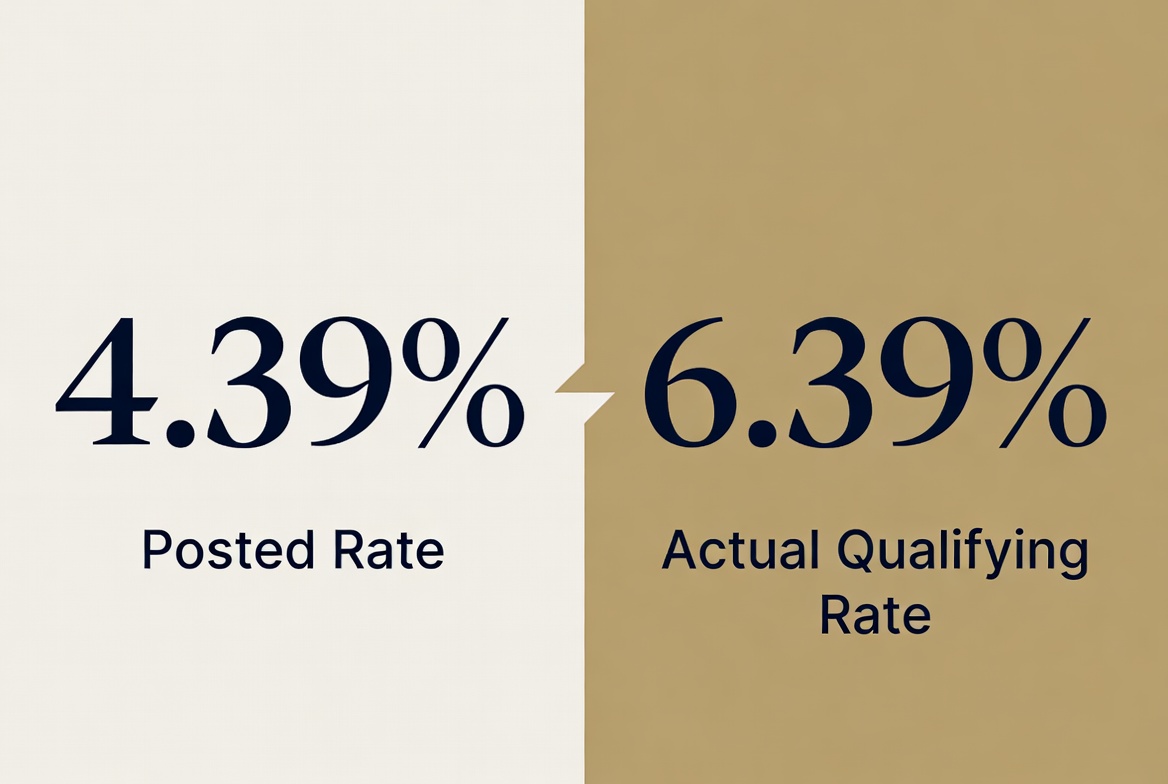
Most people assume the stress test is verifying today's affordability — can your income cover this payment right now. It isn't. As of 2026, federally regulated lenders must qualify you at whichever is higher: your contract rate plus 2%, or 5.25% (OSFI's minimum qualifying rate). So if you're being offered 4.39%, you're actually being qualified as though your rate were 6.39%.
That gap between the rate you'll pay and the rate you're tested against is the whole mechanism — it exists so a rate shock a few years down the road doesn't put you underwater.
Why does this catch people off guard?
Because the number you see advertised — 4.39%, 4.59%, whatever the posted rate is — isn't the number that determines your maximum mortgage. Your qualifying rate is. Two buyers with identical income can qualify for meaningfully different mortgage amounts if their contract rates differ, because the stress test rate shifts with it.
This is also why a rate drop doesn't always mean an equivalent jump in what you qualify for — if the drop doesn't cross the 5.25% floor, your qualifying rate doesn't move at all.
Does the stress test apply to everyone?
It applies to all federally regulated lenders (banks, most credit unions under federal charter) for both insured and uninsured mortgages. Private lenders and some provincially regulated credit unions aren't bound by OSFI's rule the same way — part of why private financing can sometimes work for a borrower who's stress-test-constrained but has strong equity or income that doesn't fit a T4.
What does this mean for you before you shop?
Know your qualifying rate, not just your contract rate, before you fall in love with a listing. It's a five-minute conversation that tells you your real ceiling — not the one the posted rate implies.
Sources: OSFI B-20 Guideline, Bank of Canada.
Patrick Sawler
Principal Broker, Craigburn Capital
I look forward to hearing from you in regard to your mortgage needs.
902-465-5533. I answer.
Patrick
p.s— You can click on this link to start the process whenever you are ready. Schedule your meeting with me here.
p.s.s— I should tell you that I am licensed in Nova Scotia Brokerage (2025-3000179) Broker (2025-3000180), Ontario (M23006699).
p.s.s.s— You can download my new mortgage app here
Patrick Sawler is a mortgage broker and owner of Craigburn Capital, licensed in Nova Scotia and Ontario, with private financing available in New Brunswick and PEI. He answers his phone.
Ready to have a real conversation? Call 902-465-5533 or start your application here.